By Rev. Elmarie Dercksen, Khanyisile Phillips and Carl Collison
As we reach the end of Transgender Awareness Month, we still find ourselves faced with the harsh reality of staggering violence against transgender people. Yet, beyond the horror, we must confront the deeper, systemic issues at the heart of this violence—namely, the intersection of gender identity, bodily autonomy, and religion.
Over recent years, the right to live authentically in one’s gender identity has become one of the most hotly contested aspects of human rights—particularly within religious circles, where the principle of bodily autonomy often clashes with religious dogma.
This year’s Transgender Awareness Month is especially poignant against the backdrop of the recent Queer Kairos Document, a bold call to action urging churches in South Africa to embrace LGBTQIA+ individuals, affirm their humanity, and practice radical love and justice.
The words “We Are Gatvol” encapsulate the anger and exhaustion of our community, worn down by religious institutions that claim to offer love, but instead promote hate, rejection and exclusion.
In South Africa, these religious institutions have long shaped societal views on gender, often viewing non-binary or transgender identities as incompatible with faith. Their influence extends far beyond the pews, into families, communities, and even legal frameworks. By refusing to recognise the bodily autonomy and self-determination of transgender people, churches perpetuate an environment of systemic and symbolic violence.
One horrific example of this violence is the murder of Phoebe Titus. On 27th of December 2015, Phoebe, a Coloured transgender woman, went to a local tuckshop in the Western Cape to buy ice cream. A minor confrontation ensued when she accidentally stepped on a 15-year-old boy’s toes, who then hurled transphobic slurs at her. The situation escalated when an adult handed the boy a knife, which he used to fatally stab Phoebe in the neck. The case, riddled with failures of the justice system, exemplifies how societal and religious biases conspire to render transgender lives disgraceful.
Close on a decade later, transgender persons across South Africa continue to face disproportionate levels of violence. In August this year, in Johannesburg, a young transgender woman died after being shot nine times while on her way home, after a night out.
These are but two reported cases in an ever-increasing number of transphobic attacks across South Africa.
The growing number of hate murders highlights a pattern of unchecked violence against transgender bodies, too often ignored or excused by both the public and institutions that should be protecting the most vulnerable.
Religion is often used as a tool to further the hate directed at LGBTIQA+ persons – and transgender peoplepersons, in particular. Queer rights activist, Bandile Mokoena, says: “Religion remains a powerful force shaping attitudes toward LGBTQ people in South Africa and across Africa. The alignment of religious beliefs with traditional values creates challenges for LGBTQ acceptance, which impact the safety and well-being of queer individuals in the country.”
Mokoena adds: “Christian Evangelical movements, often backed by conservative organizations from abroad, have gained considerable influence in South Africa. They have been spreading anti-LGBTQ ideologies, framing LGBTQ identities as moral failures and threats to family values. This has contributed to the entrenchment of homophobia within religious and cultural discourse in the country.”
But the violence faced by transgender people is not just physical. It is spiritual. It is emotional. It is in the rejection from families, friends, and religious communities that deny their right to exist authentically. This form of spiritual violence is perhaps the most insidious because it cloaks harm in the language of faith. Transgender persons are forced to choose between living their truth or being accepted within their religious communities, leading to deep, soul-crushing isolation.
The intersection of religion and gender identity is no more apparent than in the debate over bodily autonomy. In many religious spaces, the body is seen as sacred—but only if it conforms to strict binary interpretations of gender. For transgender people, asserting their gender identity is an act of reclaiming that sacredness, a statement that their bodies and identities are not aberrations but reflections of the divine diversity of creation. Yet, religious doctrines often paint this autonomy as a form of rebellion or sin, further marginalising transgender persons.
The Queer Kairos Document challenges this view head-on. It demands that religious leaders not only acknowledge the existence of transgender people, but celebrate them as part of God’s creation. It calls for a transformation of religious spaces from places of exclusion and judgement to sanctuaries of love, justice, and acceptance. Such a transformation is not only possible, but necessary, if we are to prevent more lives from being lost to the violence propped up by religious intolerance.
As we come to the end of this year’s Transgender Awareness Month, let us honour the lives lost to anti-transgender violence, while also reckoning with the systems of oppression that fuel this violence—systems deeply embedded in religious and cultural doctrine. The fight for bodily autonomy is not just a personal battle for transgender people; it is a collective struggle for recognition, dignity, respect and safety. Religious institutions must confront their role in perpetuating hate and division, whether through physical, emotional, or spiritual violence.
Let us demand more from our religious leaders. Let us challenge them to live up to the values of love, justice, and compassion that they preach. Bodily autonomy is sacred, and the right to define and live in one’s gender identity is a human right.
The path forward is clear: the transformation of religious spaces from places of exclusion to places of healing and sanctuary, where all bodies are affirmed, and all identities are celebrated. If we are to build a world where transgender people are not merely tolerated, but truly accepted and respected, this transformation is not just an aspiration—it is an imperative.
* Elmarie Dercksen is a Reverend in the Dutch Reformed Church in Bloubergstrand, and an ally to the queer faith community.
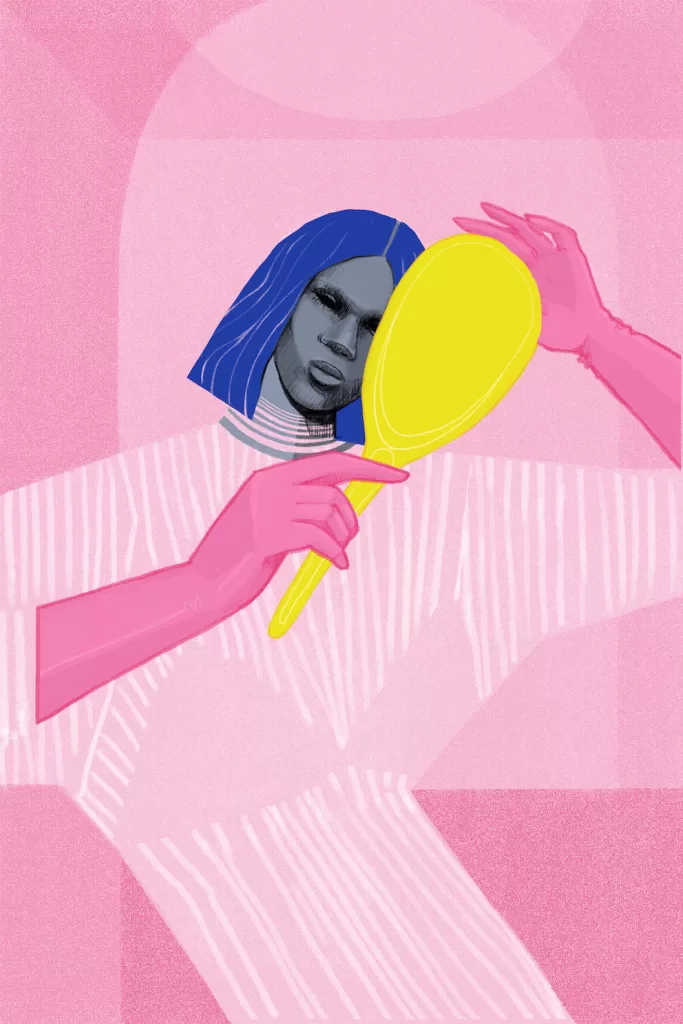
* Illustration by Dustin August, which features in the anthology, Love, Trouble, kindly supplied by Taboom Media. See more of Dustin’s by following their Instagram page, @dustinxiii