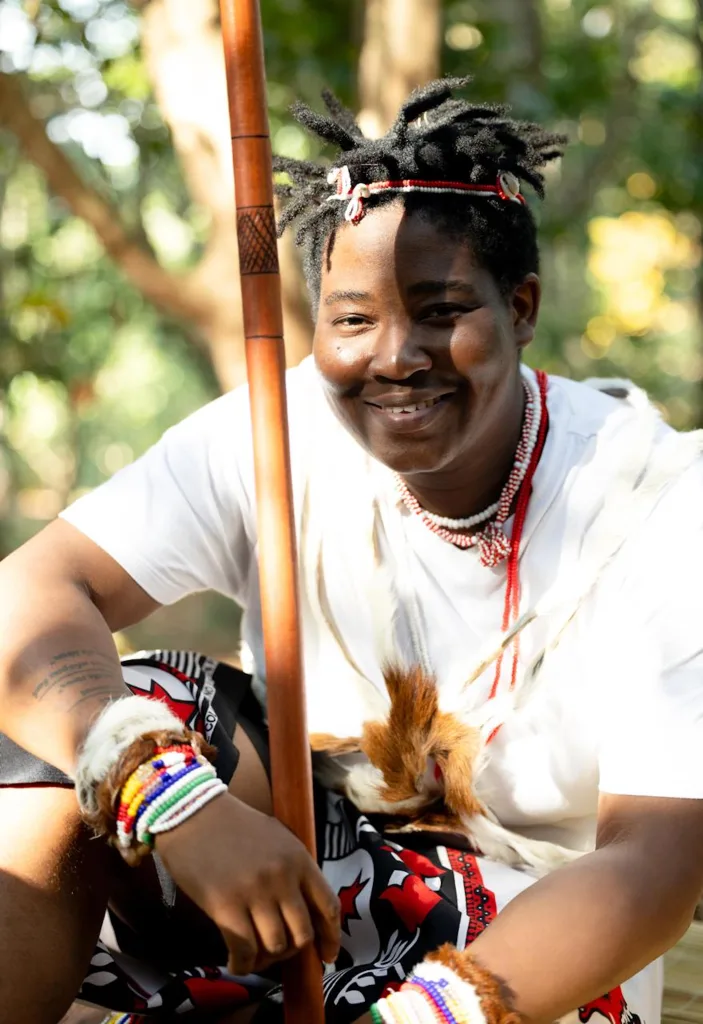
By Mkhulu Vusi
Before I had the language, my grandmother gave me the truth. I was 33 years old and in the darkest place of my life. My family had rejected me because of my gender identity, and that rejection had driven me into a severe depressive episode and thoughts of ending my life. I was 33 years old the day I went into a deep spiritual trance. The kind that does not ask permission. The kind that comes when your ancestors have decided you have waited long enough. She came through – my late maternal grandmother. She did not call me by the name the world had given me. She saw me, the man I knew I was and she affirmed it – in that space between the living and the ancestral – with a certainty that no clinic, no document, no government policy has ever matched. That moment is why I am still here. It is also why I am angry.
March 31st was International Transgender Day of Visibility. In South Africa, in 2026, that word – ‘visibility – sits in my chest like a heavy boulder. As transgender people today, we are visible enough to be studied. Visible enough to be harmed. However, it seems, not visible enough to be protected.
In early 2025, When the Trump administration cut funding to key and vulnerable populations in South Africa, the consequences were brutal, resulting in the collapse of gender-affirming healthcare and psychological support – the basic infrastructure that allows trans and gender-diverse people, particularly from underserved communities, to align their bodies with their truth. Defunded. Dismantled. Sacrificed at the altar of an ideological war waged from the White House, while the wounds opened here in our bodies, across our city, our country, our continent. The safety net was never truly ours; merely borrowed. And the lender has called it back.
What has kept many of us breathing is not the government. It is each other and the organisations that refused to abandon us: Triangle Project providing legal support and counselling on the frontline; Inclusive and Affirming Ministries, a faith-based organisation which has created spaces where gender and spiritual belonging are not in conflict; and the Quaker Peace Church, whose worship services they call ‘friends meetings’, a term which, in itself, signals the meeting of spiritual and psychological safety for those who need a sense of belonging. There is also the Desmond Tutu Health Foundation, which integrates gender-affirming care into HIV care, mental health and primary healthcare. Gender DynamiX, for their part, continues the work of documenting, litigating and advocating where it is hardest. These organisations are doing extraordinary work under impossible conditions.
Seeing civil society organisations carrying what the State should be carrying is, however, not a success story. It is an indictment.
There is also a dimension to trans and gender-diverse lives in our villages, towns, and cities that does not appear in health statistics, but lives in the body just as surely as any hormone. It is the experience of moving through the world itself. Getting on a minibus taxi when you are visibly gender-nonconforming is not the same experience as for cis-gendered people. Or walking through a train station late at night and being clocked by the wrong person. There are risk calculations trans and gender-diverse people have to make every single day: Which route is safer? Which way of dressing draws less danger? The mental load of navigating one’s way through the world as a trans person is exhausting in a way that has no medical code, but which has very real consequences.
#UniteBehind, as an organisation, has been reiterating that transport justice and gender justice are the same struggle. You cannot claim to be fighting for the poor and the marginalised while leaving trans people to navigate the challenges they face. Trans bodies are also poor. Are also African. Are also ours.
There is a narrative pushed aggressively by those who wish to erase us, that states that transgender identity is a Western import; that to be trans in Africa is a colonial by-product. I have heard it in parliament. I have heard it at community meetings.
But my grandmother, as an ancestor, disagrees – and so does history. Becoming isangoma (an indigenous healer) is not a career choice. It is ubizo, an ancestral calling that will not be refused. A female sangoma possessed by a male authoritative ancestor is addressed as uBaba, may carry a shield and spear, and moves in the world as the ancestor requires – not as the body was assigned at birth. This cross-gender identification is not incidental to the healing practice. It is the source of its power. Research has found that ancestral influence can lead isangoma toward a transgender identity not as disorder, but as spiritual calling. In African cosmology, souls that carry this androgynous energy are not broken. They are blessed.
To claim that transgender identity is un-African is not a defence of culture. It is an erasure of it. It was colonialism that criminalised gender identities and installed the rigid binary we are now told to defend as ‘authentically African’. The missionaries did not find a continent of two fixed genders. They tried to create one. We are proof they did not fully succeed. Siyakhuleka emakhosini, makhosi! (“We pray to kings, kings!” – a greeting used by Nguni traditional healers.)
This tradition is not only ancestral memory. Ubom Bam Luvuyo LGBTQIA+ Traditional Healers Forum advocates for queer traditional healers and initiates in conservative spaces, insisting that their identities and their spiritual authority are not in contradiction. In a landscape where culture and traditional leadership is frequently weaponised against LGBTQIA+ people through conversion practices, the Forum is taking those structures back by supporting the visibility and inclusion of sexual minorities and gender-diverse people. This empowerment allows us to exist in the sacred spaces where conservative gatekeepers would prefer we did not exist.
So, what does visibility mean in 2026? It cannot mean a photograph and a hashtag. It cannot mean a government statement from a Department. Real visibility means ring-fenced public funding for gender-affirming healthcare as a Constitutional right, not a donor-dependent programme. It means sustainably funding organisations on the ground through domestic resources, so that their survival does not depend on the White House – or the whims of any foreign nation. It means public infrastructure, transport, lighting, and public space built with the explicit safety of inclusivity in mind.
Visibility without protection is, after all, just exposure. I am not asking to be seen. I have always been seen by my ancestors, by my community, and by those who wish to harm us. I am demanding that those with power act as though our lives matter beyond 31 March. Beyond the awareness month, beyond the moment the cameras turn away.
Years since the day my grandmother affirmed me for who I am, I have spent every day since trying to build a world that agrees with her. That is not a Western agenda. That is African love and it deserves African protection.
- Mkhulu Vusi is a transgender man, African indigenous healer, and communications professional. He researches and advocates on sexualities, gender, and queer studies, and is based in Cape Town, South Africa.