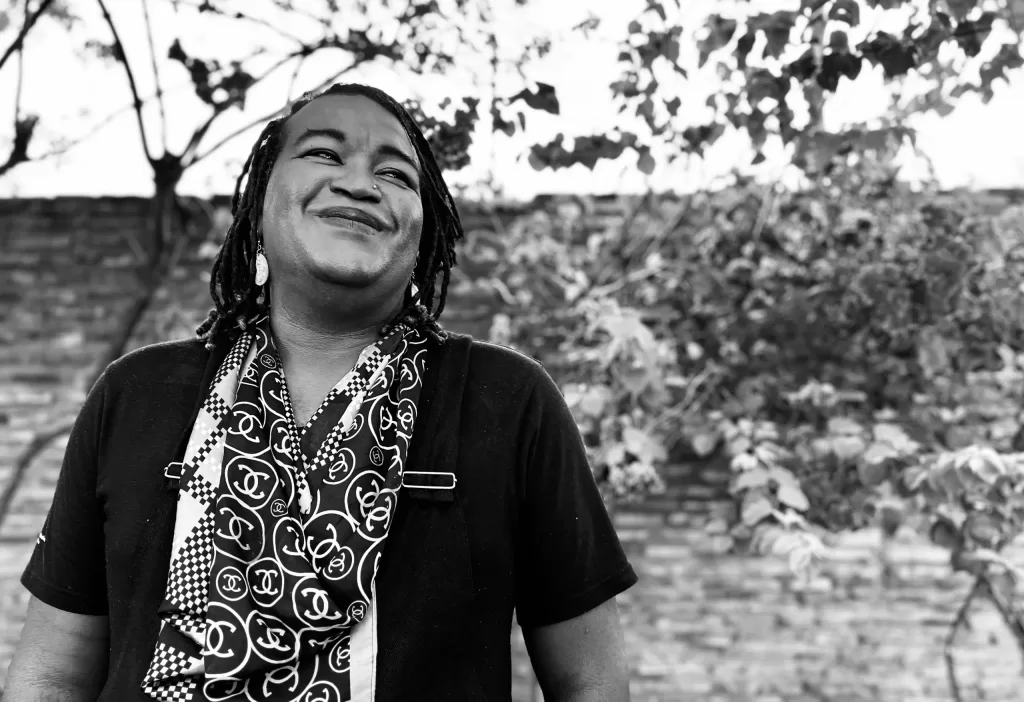
[Photo: Carl Collison]
At only 38 years old – but with years of trans rights activism behind her – Jholerina Timbo is considered one of the elders of Namibia’s queer rights movement. In this interview with Carl Collison, Timbo – or “Madam Jholerina” as she is affectionately known – speaks about the difficult early days of trans rights activism, the effects of the anti-queer movement on the country’s trans communities, and her respect for the new generation of trans rights activists.
Carl Collison: Let’s talk about Wings to Transcend Namibia (WTTN), the trans rights organisation you established in 2018. Why did you establish the organisation?
Jholerina Timbo: We officially registered it in 2018, but we [were doing work] before our official registration. During that time, the only organisation that was in the country – or that was visibly doing work – was Outright Namibia. And, basically, their approach was a blanket approach for all the [LGBTIQ+] community members. So, there was no actual progress or investment into realising transgender people’s needs… So, my feeling was it is time that we, as trans people, organise ourselves and start a movement of our own.
CC: I see you were a Mandela Washington Fellow [in 2018] and part of the Young African Leaders Initiative in 2016. What would you say this level of international exposure and engagement brought to your activism?
JT: So, for me, it deepened my conversations around what it is that we need to do as a community to be able to address our challenges, right? So when we started WTTN, our thought process was like, “Yeah, we should meet; we should talk; we should discuss.”
But I think being exposed to the outside world and being part of all of these different learnings made me zone into the actual needs as a community. Legally, particularly, that was the challenge. Because if you don’t have legal agency, then a lot of other things – access to other things – are impacted, right?
And a lot of trans women in Namibia still did not understand this whole concept of being trans. That was also something that we needed to work on, because trans people still did not understand themselves. They still said, “I’m a gay woman” and all of these things. So we had to do a lot of community engagements to be able to make people understand what sexual orientation is [and] what gender identity is. And also, you know, as trans people, we used to have this narrow understanding of being trans: that it’s only about our gender identity. We never spoke about our sexual orientation as trans people.
So, those are some of the things that I was exposed to: to sit back and look at myself and say, “Okay, yes, I do have an identity, [but] what is my orientation?” And so we had to look at all of those things and start having conversations around those types of topics.
Also, you know, the issue of sexual practice is also something that we hardly speak about in the trans community. Because we judge each other, right? You can’t be a hyper feminine trans woman and, for example, say, be a top in bed, right? So there are still those gaps and challenges that we are faced with. Because when we started the conversation, there was a lot of resistance because people would stigmatise each other, and be like: “Look at this one. She’s koma (apparently) claiming to be a woman, but she’s also topping men. What does that mean? You are vilifying the movement.” Those kinds of things So, we started a bit of that conversation based on my exposure, but we still are sitting with that struggle in-country.
CC: Earlier, you mentioned that there was a time where trans women would say, “I’m a gay woman”. But what I think you meant is they would say, “I’m a gay man”. That they would think of themselves as gay men. Is that correct?
JT: No, there was a concept of ‘gay women’ in Namibia, where people [identified] themselves as female and did not [yet know] the concept of trans… because they were not even exposed to the term ‘trans’, right? People only knew ‘gay’ and ‘lesbian’. So, rather than saying, “I’m trans”, they would say, “I’m a gay woman.” They wouldn’t want to be called a man, so they would rather be seen as a gay woman. So there was that conversation…
CC: Wow. Interesting.
JT: Yeah… When I got exposed to the community, I thought I was gay, because that was the terminology that we were exposed to: ‘gay’ and ‘lesbian’. So, for a while, I felt like I belonged to the gay community. But then, even amongst gay people, I never felt I fitted in perfectly. Because the conversations and things were being done … did not quite fit me neatly. So I still had uncomfortabilities in the gay movement.
But by the time I got exposed to the term ‘transgender’, that’s when I exhaled. When I read and learned and understood and did research and saw all these other trans people in the U.S. and all over the globe sharing their journeys, I was like, “Now, this is me. This is exactly how I feel. This story describes who I am. This person is talking about me.” So, that’s the … time that I realised that this is exactly where I fit in… That was in 2008.
CC: How are your parents with you? Do they support you?
JT: My parents are firm supporters of me and my gender identity. My mother literally left [her] church because they wanted to have a witch hunt for LGBT people. My mother was an elder in the church. But when the other elders started talking about “we need to pray for these homosexual people” and “we need to do something [about] these homosexual people”, my mother literally walked out of that church and never looked back.
CC: Shit. That’s amazing. And your dad?
JT: So, my biological father passed away in 1997 in a car accident. But my step-dad is quite supportive. He corrects people when they misgender me. It’s the same with my mom. She corrects people when they misgender me. And also within family settings, or when we are shopping or whatever, they are usually my support and my strength. So, yeah, nobody dares to mess with me. Sometimes, I don’t need to defend myself. If they are with me, they are the ones who just go at it with people if they are trying to be funny. So, I have the greatest support system. I think that is one thing that also strengthens me and keeps me going: knowing that at least, if push comes to shove, I have a support system that will always be in place to hold me and care for me. So, yeah, my parents are very supportive.
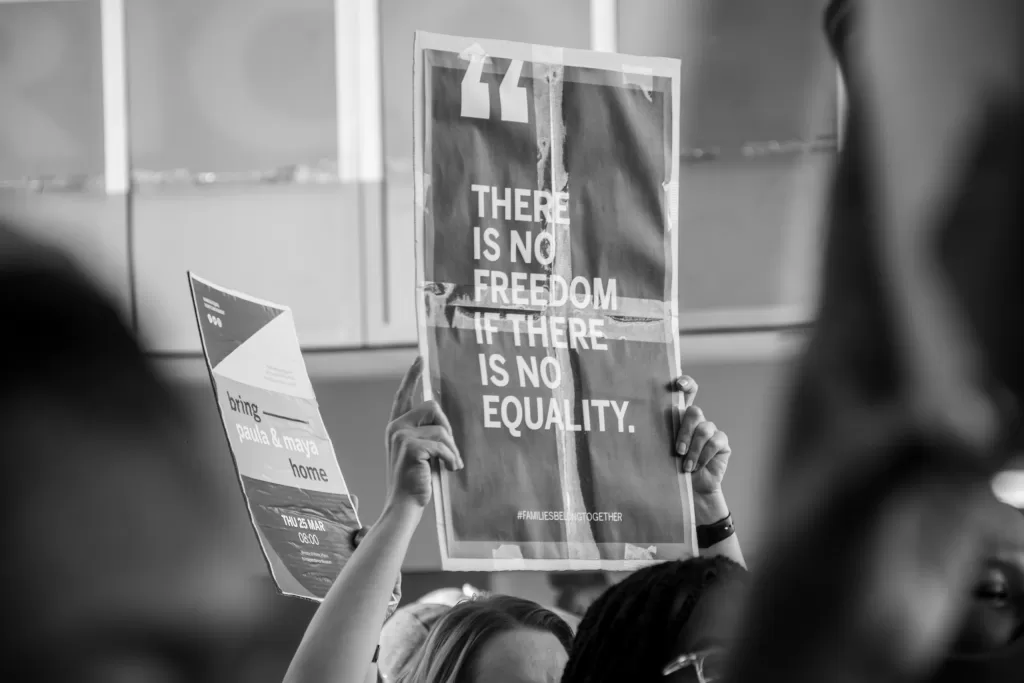
[Photo: Supplied by Equal Namibia]
CC: Phew, that is so beautiful to hear. Tell me, what would you say is the most difficult thing for you, as a trans person, living in Namibia?
JT: You know, I can give you a list. I can give you a list. It is not easy. So, number one, I think it’s around access to affordable gender-affirming care or gender-affirming surgeries. Because even right now, when you walk into a space and you provide your ID, you are told it’s not you and that [you] must give [the] correct documentation. And, you know, as much as I want to complete and do my whole surgery, financially I’m not able to at this moment. So, you know, that anxiety of me having to go into the street and having somebody ask, “Is it a man or a woman?” You know, being … [this] kind of, like, human no-man’s zone. [So you are in this] no man’s land kind of situation. It makes [having] access to even my own bank account a problem. It makes using public facilities a problem. It makes… it makes life hard. And also not being given the recognition by my country as a human being. As a transgender person, you know, the legal omissions of being trans in this country is problematic. Because people don’t understand. And because our legal system doesn’t explicitly say, ‘sexual orientation’ or ‘gender identity’, it leaves loopholes for people to discriminate and stigmatise and even deny us access to services – or entry into spaces.
So, it’s one of the hardest things that one needs to face. That you need to mentally prepare yourself for all the challenges when you leave your front door. When you open that door, and just walk out, you know, immediately, beginning in the street, you will be stigmatised and discriminated [against] all the way till you get to your job. … You mentally need to prepare yourself, because people will be staring at you. Some will be laughing and giggling and pointing at you. So the landscape itself is very… stagnant and discriminatory – especially when politicians throw hate speech and talk nonsense about the LGBT movement. And you know, when they say, ‘homosexuality’, we all as the LGBT community are subjected to it. So it makes our lives harder.
Even a nurse is unwilling to provide services at times because we are seen as illegal or deemed illegal. When you go to police stations, you go through secondary victimisation. They laugh at you, they make fun of you, they will tell you, ‘You are a man, why did you not beat the person back?’ All of these things, you know? So, the uncomfortability that we face when we are accessing services – even public services – it’s really… It’s really painful. It is painful that you need to mentally, emotionally, [and] psychologically prepare yourself to do anything in this country.
CC: Since the Supreme Court ruling [in May 2023, that same-sex marriages entered into outside of Namibia should be recognised], and the subsequent anti-queer pushback, what has the environment been like for trans people?
JT: It has been exacerbated where I even feared for my own life. You know, I feared even going into a shopping mall. I had to always go with my mom or my dad or my siblings as an extra layer of support, because I felt that with this homophobic pushback [and] all the rhetoric I was hearing and seeing on social media – the threats [and] the hate group conversations – it really placed me in a very anxious place.
You know, I for one had my own mode of transport. But so many trans people have to take public transport. And the harassment that some trans women went through just getting in a taxi… How people wanted to grope their private parts to confirm whether they are men or women, you know, because they felt it [was] justified by all this homophobic rhetoric by churches and politicians. You know, [people would be] waiting for a taxi and then be attacked by people, [with] others just standing and watching. All of these things really placed so much strain on our communities, mentally and psychologically. And also physically, because some people had to call [the police] multiple times to make cases. Sometimes the police would just not want to take any more cases. All of these things. So during this time, our community was … being violated and abused. People felt that, because of the rhetoric, it’s justified to hate openly. People that we thought were our friends were hate-speaking and being transphobic on social media… It just showed [us] that we should be relying on one another more than relying on other people, because you never know when they might turn. So, we went through all of this emotional [and] psychological trauma. And I think it’s something that we haven’t actually sat down and spoken about and addressed, until now.
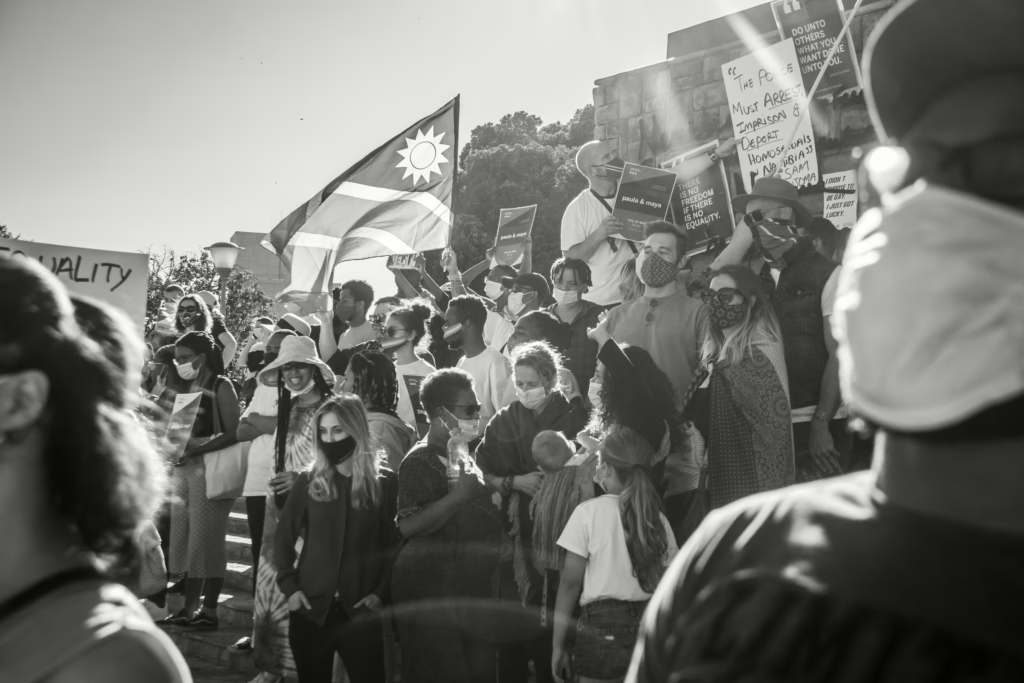
CC: What are your thoughts on the younger generation of trans folk in Namibia?
JT: I am super, super proud. I’m super, super happy. Because when we were growing up, we were only a handful. And today, in this age, we see more and more visible younger trans people taking up space; not sitting and waiting to be given an opportunity. They go out there and they just live their best lives. So for me, I’m quite happy and excited.
Sometimes I think they’re a little bit radical. But I think that is needed. We have been trying to be very diplomatic all the time. For years, we have been trying to be nice. We have played nice, only to realise, when this judgement came, that people we thought were allies – people that we had meetings and ongoing engagements with – were being homophobic. I was like, “You know what, I think the youth are right. They are tired.” The youth are correct, because we have done it the other way. We have tried it the other way of being diplomatic; not causing noise. You know, going to meetings with parliamentarians; meetings with Standing Committees in Parliament; training for parliamentarians. We have been doing all of these things, but it seems like nothing has actually caught on. And I’m like, “You know what, the youth are right. Let them be radical. If they want to burn down parliament, let them go and burn it down.”
We’ve been going to the United Nations [UN] and handing in Shadow Reports. We have been engaging them in the UN and all of these places, but what is happening? No change. And you see that when main political party parliamentarians make [queerphobic] statements, you would expect at least the opposition to retaliate and uphold human rights. But you see these people sitting there clapping hands – all of them, in Parliament – when these statements are made. It angers me. So I feel the youth are justified to use the language that fits them to express themselves, to advance and advocate and go out in the streets and make noise. I support that wholeheartedly.
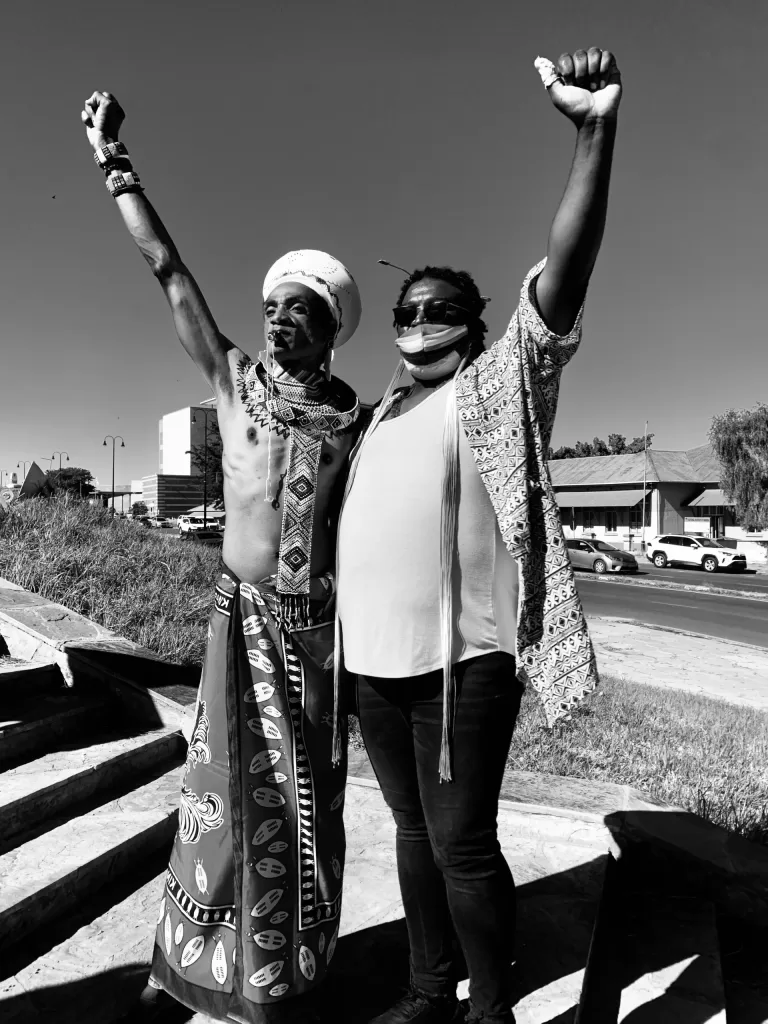
CC: [Fellow trans rights activist,] Deyoncé [Narris,] is about your generation?
JT: Oh yes, Deyoncé is a granny like me (laughs). Then there is Mama Africa. I was not in Mama Africa’s generation. She was part of those youth movements during the liberation times and the fight for independence. She’s one of the first [queer] people that we heard about. And older people always reference Mama Africa when you talk about [being] LGBT. They’d be like, “Oh, like Mama Africa?” So, older people that don’t understand our terminologies would refer to Mama Africa as, you know, “Oh, so you are like Mama Africa”.
CC: Who do you rate among this younger generation of, particularly, trans activists?
JT: Ha! There are so many. So many. One of them is Kourtney Reinecke. I would say she is one of the formidable trans women in the country. I would say Omar van Reenen would be one of the formidable siblings out there. I would say… who else is there in the movement? I would say Arila Garaj. Yeah, she started an organisation to work with rural communities.

[Photo: Supplied by Equal Namibia]
CC: What about trans men? I don’t see any trans men on the activist landscape here.
JT: There are very few of them. And even fewer of them are involved in any organising.
CC: Ah, ok… I get it…
JT: Yes… You know, these younger activists today, they are more resilient… They are made up of stronger stuff. I think our generation… was not as strong. That’s why we were just a handful. But these ones… Already from primary school, high school, they are living their lives out there. In universities, they are out there. And so for me, I’m happy. I’m excited. I feel they have it. Their push might just be what we need to be able to [turn] the tide. Because even with [Namibia’s] independence, you know, our heroes were not sitting and waiting for independence to be given to them. They fought for it. And I think it’s time that we utilise as much as we can – platforms and spaces and people – to be able to change the narrative and drive change. And if we have to be radical while doing it, I think that’s the best route to go. I don’t want to advise people [against] being radical. I’m like, “Use [the] language that you want to use, because the elders haven’t been learning from us, and haven’t been growing with us…” So, I’m super proud of the youth. I’m excited. I am happy. It kinda gives me a new passion for advocacy [and] the work we need to do.
Republishing guidelines: This text and the accompanying images are available to republish, at no cost, either online or in print, with the following conditions:
- The author listed here is credited.
- Beyond the Margins is credited (including a direct link to this article’s URL or the Beyond the Margins home page).
- No edits are to be made to the text and/or images. Any desired edits need to be approved by either author and/or photographer and/or Beyond the Margins.
- None of the content here may be resold separately.
- For any questions, please email: marginseditor@gmail.com
This interview was made possible with support from the Cape Town office of the Heinrich Böll Foundation.