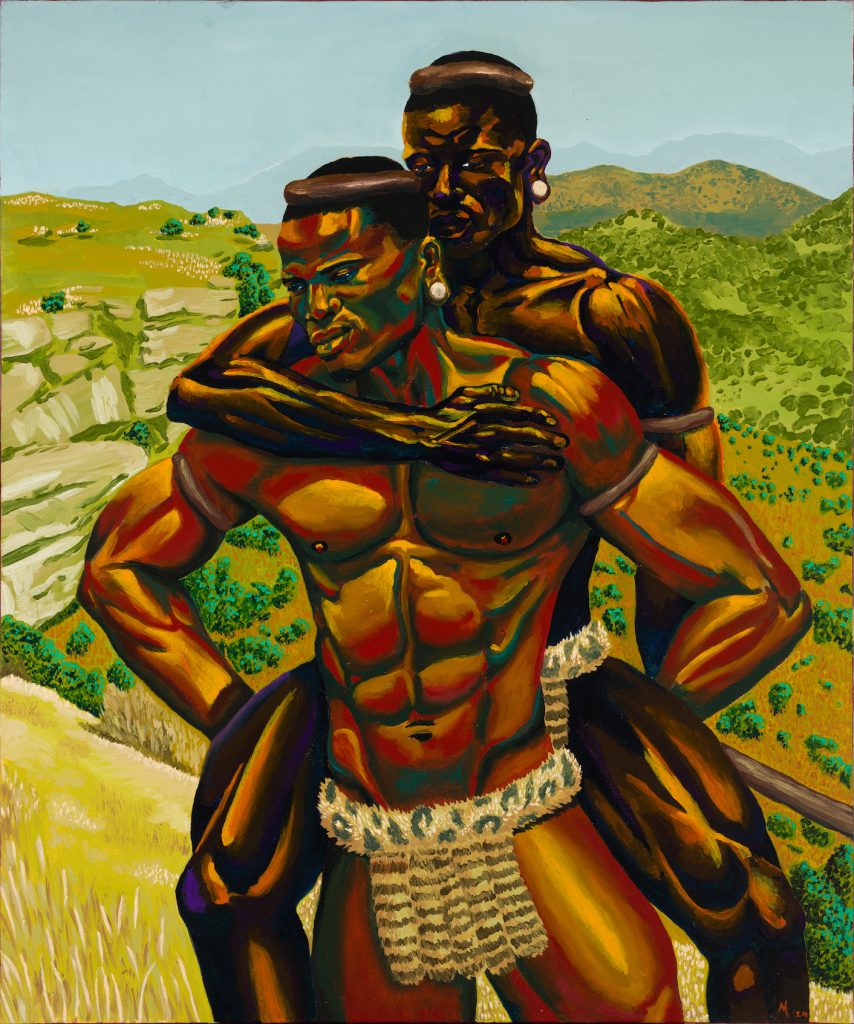
The often fraught relationship between traditional beliefs and queerness was yet again thrown under the spotlight a few weeks ago, when, following the wedding of a Zulu same-sex couple, former radio host, Ngizwe Mchunu, encouraged “Zulu people to block same-sex weddings where queer people wear Zulu traditional attire”.
In this In-Conversation piece, for Beyond the Margins, the multidisciplinary artist, Desire Marea, spoke to Mpumelelo Zamokuhle Zulu, a social scientist and scholar-activist whose work explores the intersections of gender, sexuality, violence, and culture, about this recent controversy, the constantly changing nature of Zulu belief systems, and the ways in which queer persons have – and can continue to – find their homes within Zulu culture.
Mpumelelo Zamokuhle Zulu (MZZ): What are your thoughts on the recent events surrounding imvunulo (traditional attire) that ubaba [uNgizwe] has shared on social media? Because, looking at all that is being reshared, I’m noticing that there are two cases being made. The first one being the two men who got married ngokwe sintu bebagqoke imvunulo yamaKhosi (wore regalia that is reserved for royalty during their traditional wedding ceremony), wearing imvunulo yamaKhosi (royal regalia), which nobody outside of the Royal family should be wearing. Secondly, ubaba and many other people on social media have been saying that indoda ayilalani ngenye indoda (men who have sex with other men) should not wear imvunulo. I wanted to hear your take on this.
Desire Marea (DM): As far as imvunulo goes, I think a lot of cis-gendered, heterosexual Zulu men like to weaponise culture when they need to oppress some people – and the things that they use are often irrelevant. I’ll make an example with the fact that women can’t wear pants in eNdumbeni or like eSgodlweni (iNdumba/iSgodlo is a sacred building built for isangoma* to connect to their ancestors, consults clients, and store their medication and spiritual ornaments) in some because they appear to be naked, but at the same time they wear pants and you know, it’s a double standard, used to oppress women. Like gqoka isiketi (wear a skirt) otherwise kuba ngathi unqunu (it’s like you are naked). Whereas the pants silhouette is also a new thing so the men are also naked, right?
That’s just one example. There are many other examples and I think even in this scenario, they are just doing that in order to further oppress a minority group, which in this case are queer people as they call them izitabane. Yeah, and with imvunulo zamaKhosi and all of that, you see straight men who are not descendants of royalty wearing imiqhele (Zulu crowns) that are designated for people of a certain role in society. So all of those lines have been blurred and nobody is enforcing it. But when queer people want to own a piece of themselves, which is owning a piece of their heritage and their culture, then they want to come and police that. So it’s invalid. I don’t even want to get to the details of what imvunulo is. The actual intention is flawed.
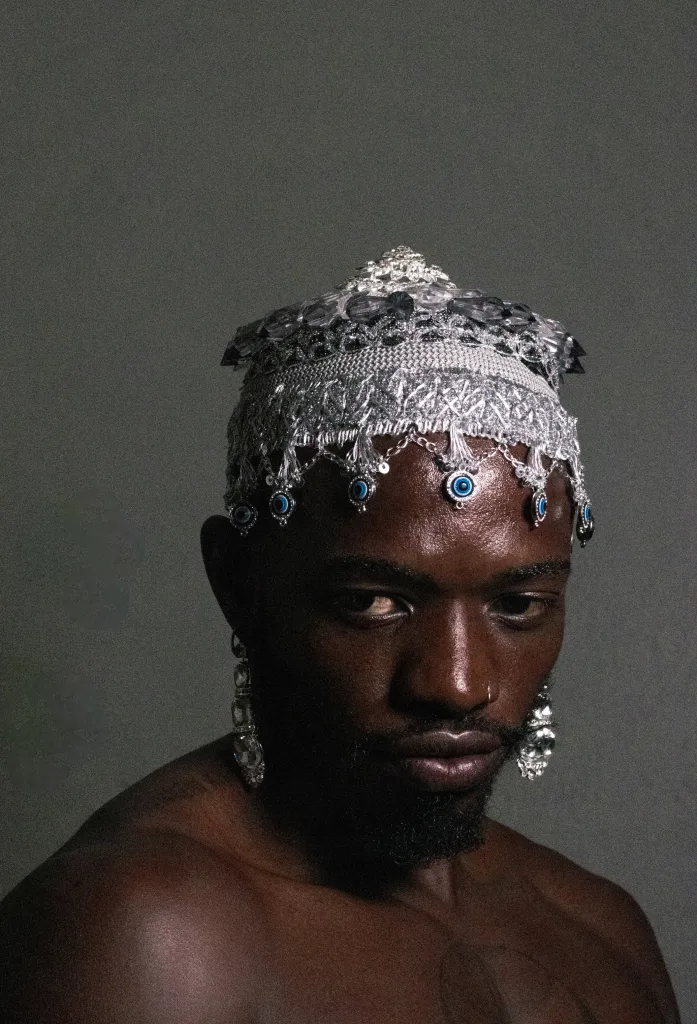
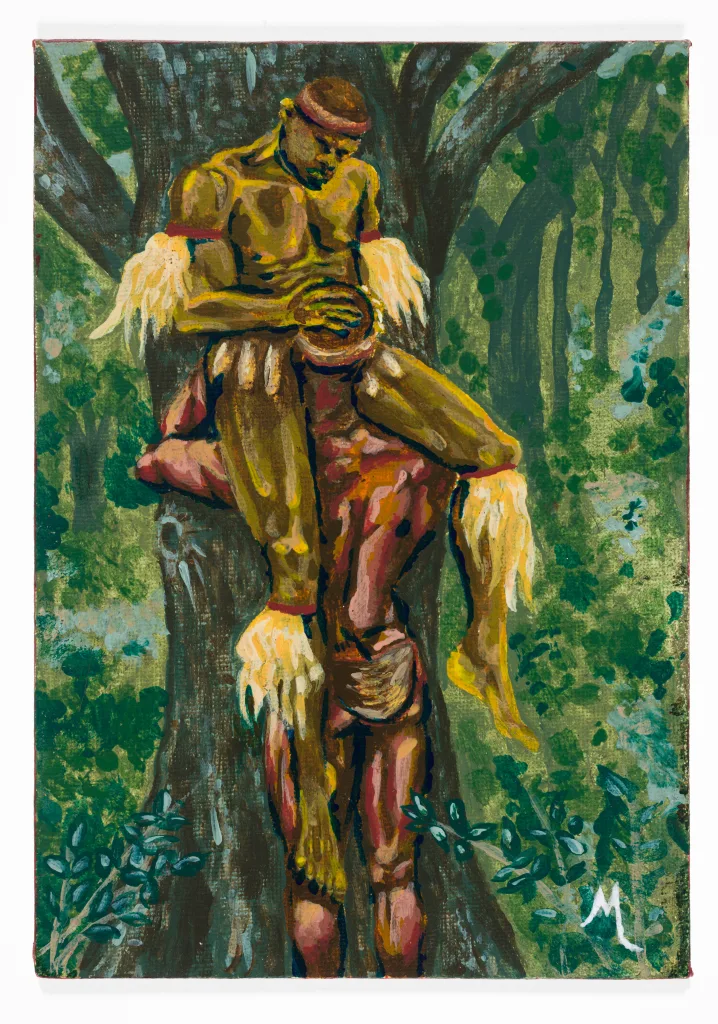
MZZ: Your body of work, the Baddies of iSandlwana, depicts what I see as really intimate moments between Zulu men, eba vunulile nabo (who are also wearing traditional Zulu attire), in all sorts of beautiful sceneries in nature. What inspired you and is there a message that your art is speaking to perhaps? Yeah, can we please say more about your art and the Baddies of iSandlwana?
DM: I’ve actually been thinking about the ‘baddies’, in relation to the current conversation with ubab’ uNgizwe and I was thinking of how I could express my point of view again and rehash it because, yeah, it’s getting out of hand. So, the Baddies of iSandlwana were inspired by amaqhawe (heroes) that I’ve seen and observed in our current times. Izinkonkoni zakwaZulu (‘queer’ men from the Zulu kingdom) who are living with courage, resilience and vulnerability and playing pivotal roles in their families and in their communities or even just for themselves.
I often like to imagine what current incarnations may have been like in previous times because I think the poetry of life is just realising that things change, but a lot of the things remain the same and you feel like there’s nothing new in the world, you know? And with this realisation, I was inspired to imagine queer people in previous times.
And if they were the heroic beings that I believe them to be, they definitely would have been eSandlwana fighting for their kingdoms, their families and their children because of what they believe in. And when it was time to defend against colonialism, they were very resistant, fighting for ubuntu babo (their personhood and humanity).
We were there [then], because we are here now, fighting for similar things. Nothing has changed. That was my inspiration for that. And I think it is important for us to imagine ourselves in those times because we are always treated like a new thing – and when you separate us from ubuntu bethu (our personhood and humanity), you basically take us away from home. And we have a very compromised experience of what home is, you know? Home in its entirety, beyond our physical homes, but a home in an order, in a belief system, ku isintu (a people’s way of doing things, inclusive of but not limited to, their cosmologies, spiritualities, customs, values, and relationships with others and the environment).
That is where our home is and that is what is being compromised by comments like ubab’ uNgizwe made – and other Zulu people who are homophobic and violent. So, yeah, that is at the crux of what the Baddies of iSandlwana seeks to address.
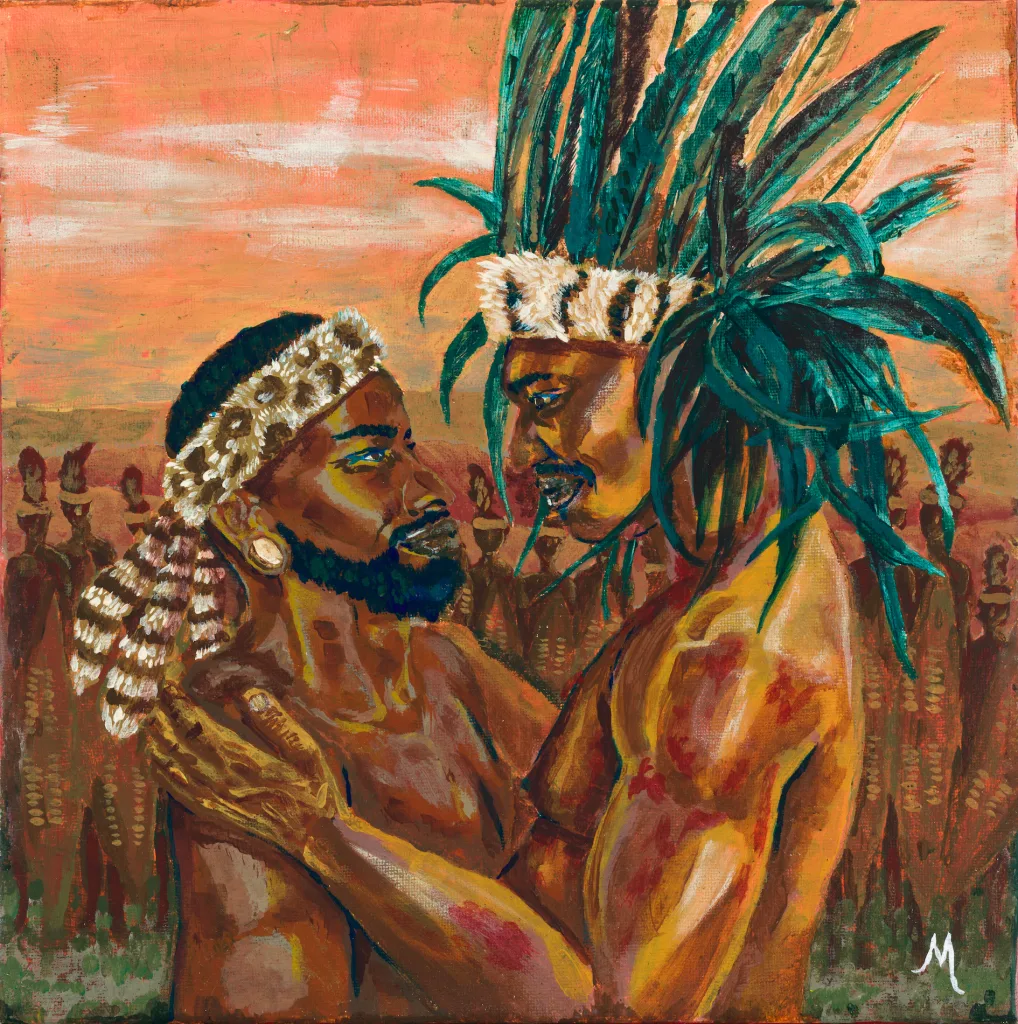
MZZ: What you’re saying is so relevant right now, around the ‘baddies’, and I think your work becomes very important because, as queer people, whether they want to call us izitabane, izinkonkoni or whatever it is they want to call us now, we are not just deprived of our history and heritage, we are deprived of imagination. And I think your work perfectly encapsulates that. That essence of imagining… Since we can’t remember our ancestors – imagining them – there’s something powerful about that.
In relation to same-sex marriage and how these couples navigate traditional weddings or traditional ways of solemnising, I started to wonder about this thing we call culture, or isintu, and about where the queer voices are…
DM: What did you find? Did you find an answer to that question?
MZZ: So far, I found that there have been pockets of queer people finding themselves, creating space. Although so far, it has been around izangoma, and abangoma (all people related to the practice of healing, inclusive but not limited to izangoma) who are really interesting people to look at when you’re thinking about queerness in southern Africa, because they don’t follow the norm for isintu particularly, because you’ll find izangoma understand gender beyond the physical.
That’s where I found histories of same sex marriage between izangoma and those kinds of embodiments of androgyny, embodiments of femininity amongst men. I found masculinity amongst women, and how the fluidity of being was just so embraced within those communities. But outside of that, I haven’t found much. Do you perhaps have more that you’ve seen?
DM: There’s so much gender essentialism in our culture, [and] how the society is built. There’s this binary that is constantly reinforced, and isintu is weaponised to defend that. And this is the one reason where I’m taken out of that belief that isintu is fully encompassing. Almost whenever I interact with isintu in contemporary times, because of that gender essentialism, it always hits me. And then I’m just like, ‘Where are we exactly?’
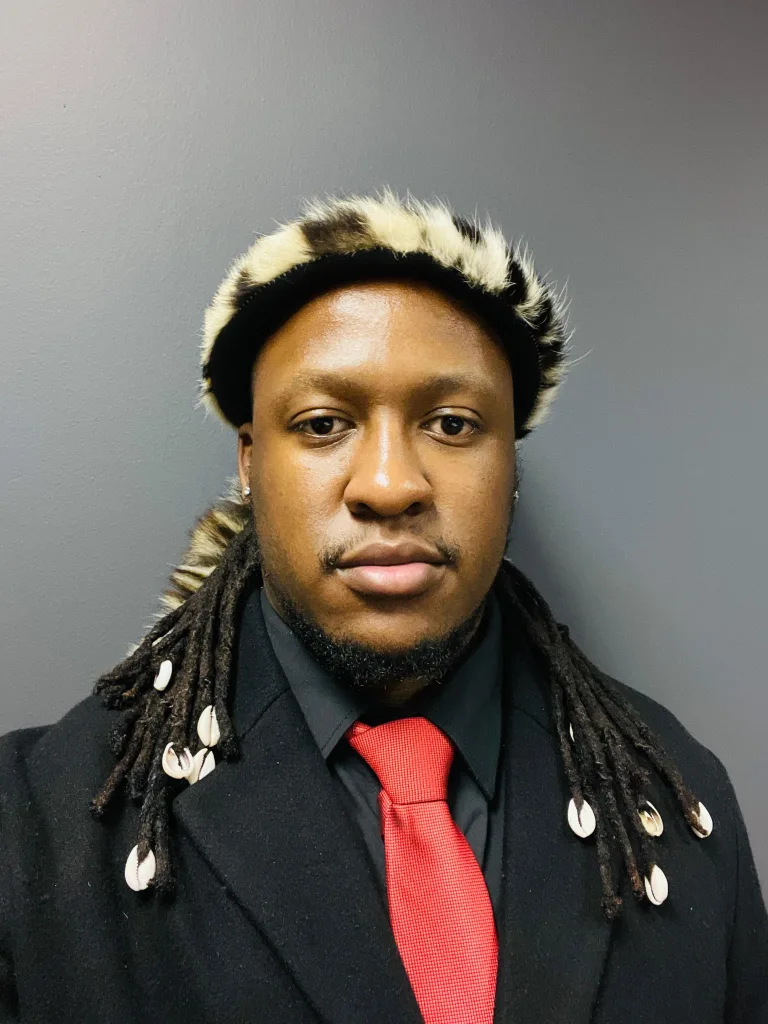
MZZ: No, I get you. And, what do we actually mean (Laughs) when we’re talking about isintu – a working definition?
DM: Yoh (Laughs). I believe isintu is an order that incubates the arcane consciousness of abantu (people). And it is an order that shields and protects our cosmology, and our history, and our sense of self, for the purpose of progress. What do you think isintu is?
MZZ: I like your definition a lot. So, perhaps if we’re thinking about isintu, then from which time are we talking about it from? Because I was shocked to find out that some of the things that I knew as blanket… isintu says when you lobola it’s always been 10 cows, and then I found out that a coloniser was the one who decided that it was going to be 10 cows, but that was never the thing.
DM: Was this Shepstone?**
MZZ: Yes, it was… the Commissioner of Native Affairs. So colonisation and apartheid also had a hand in co-creating isintu with us. I feel it came with an emphasis on this gender essentialisation by creating a norm that gender and biological sex are these two things that are married and never changing.
Thinking back to my upbringing, I would, as a child, want to tell my white teachers, ‘What about the granny that has a full beard and talks like a man? Where do I put this person who I see in my reality, but I don’t see it in your teaching, in your language? You don’t accommodate for that queerness.’ (Laughs) … looking at how language and the structures that followed from colonisation and apartheid also perhaps might have had a hand in creating this essentialisation of gender as this fixed, unchanging thing. Because we even had spiritual gender – there has always been an understanding that we exist beyond just the physical. Have you come across anything like that?
DM: Yes, even growing up… I love children because you always revolt against the binary – or essentialism – and you always question. And once your questioning is met with adult authority telling you, ‘This is what boys do and this is what girls do’, then, as a kid, you also just enforce that like, ‘No, why are you wearing earrings? Why is uncle like that?’… But I grew up with a lot of genderqueer people around, and there was no language for it. They were just people. I mean, of course, the pronouns still fit into either of the two genders that are publicly supported.
But it was different. I remember there was a grandmother who I later learned was queer, but she was just badass – like, wearing pointers, had one eye, had a patch, just so badass … and the voice as well – but that was not alien to me or to our families. So I don’t know what goes wrong when this exists in our homes, when we identify, when we want to rectify certain things that are overlooked in our quest to claim space just like everybody else in the family unit or the kingdom, because oftentimes those efforts are met with resistance from everyone who has seen so many manifestations of genderqueerness.
It’s interesting what you mentioned about isintu changing, and maybe it was made concrete via colonial interference, because… I don’t know if you watched Shaka iLembe, but they showed the moment where he stopped the circumcision rituals of young men in the culture, right? Which many cite as the reason why isiZulu people stop traditional circumcision. Some of them still do, but that is a clear example of someone who is changing something that might be seen as integral to isintu, but what was integral to isintu at that point in time was survival and protecting abantu. So they prioritise based on what was happening and they moved forward even with that change, and I wonder why can’t we do that? Why do you think that is?
MZZ: That is a really good question, because at the same time, we know isintu is this thing which is very hard to put into words. It is also very fluid. It is also very ‘queer’ in how it shapeshifts, because isintu that you practise in your house is not the same isintu that I practise in my house, but we’re both practising the same thing, which means that this thing is… negotiated. So it’s never a fixed thing, but it’s relational.
I want to read something (Laughs). In my research I interviewed people who got married to same sex partners, in accordance with isintu and then I also spoke to people who have extensive knowledge of isintu, and this is what one of them said, this definition of what umshado (marriage) is. They said: ‘Marriage is more than the union of two individuals, but it is the union of two spirits, and it is the union of two families, and it is the union of two sets of ancestors that came together for mutual exchange and mutual benefit, because of these two people coming together’.
I’m imagining a situation where two people of the same sex fall in love and start a home – or they find IVF or surrogacy and have children. They’ve legally signed the papers. But this side [traditional marriage] has just been ignored, and there’s just like, red flags, because, from my understanding, with isintu, you will always be a child, even when you’re 100 [years old] – in the sense that even our grandparents also ask for permission from their parents, their late parents, and their late grandparents, because to them, they will always be children. So, who are you to just executively decide to branch off and do whatever you want outside your community?
DM: Exactly. Now, let’s talk about the very same communities that are meant to support your union as a queer couple. Let’s say you do want to get married traditionally. The very same community that are going to be witnesses when certain rituals are being done, often do not support umshado between queer people. And a lot of queer people who are African, the common denominator is that a lot of modern day or contemporary cultural practices do not necessarily recognise their unions, or they aren’t set up in a way to immediately recognise those relationships. So, on one hand, I understand the motivations of queer people who decide to go the marriage route, because that’s just too much to navigate, right?
And then on the other hand, there are people who know they are queer. And I’ve learned this from interacting with a lot of them. There’s a big community of married queer men in KZN, who either identify as DL, gay, or bisexual, or MSM, right? And these men know that they are queer. And some of them would admit that maybe my attraction skews more towards men. But because of the responsibility that you spoke about, they get married, because it’s their responsibility; it’s their cosmic responsibility, their spiritual responsibility to get married and do this one thing. And how a lot of them, it’s like, they’re not going to do that. They don’t want to get married to another man. They don’t see that as umshado, which I found interesting. So, I want to understand that union that you spoke about, of ukushada and the joining of two people and two sets of ancestors, and two destinies, that sacred union. How do we navigate that misconception, that it’s a thing that is exclusive to people of opposite sexes and correlating genders?
MZZ: You brought up something important. It’s not just the people who decline to witness your union. Sometimes it’s physical violence, death threats, people getting disowned, [simply] because they identify [as queer] (Laughs) before we even go to marriage. ‘You are saying you are what?! Get out of my house!’ So, it’s a catch-22 because it’s either you get married [legally to a same-sex partner] and without cultural and spiritual acknowledgement – and that has its own implications. And speaking to people who are conjugates of culture, they were like, ‘There’s a high chance that that relationship will not go far, because the ancestors will be angry; there will be relationship problems that you think are just physical, but they’re actually spiritual.’
One’s partner’s ancestors are going to say ‘This is our place’, and your ancestors are going to say, ‘This is also our place!’ They’re like, ‘My child bought that!’ They’re like, ‘No, but my child was the one who put the down payment for the house!’ … and whose surname are the children going to take? And those things, all that spiritual turmoil can then manifest in physical or relationship problems that might lead to the relationship breaking down.
So, that is one end. On the other end, you try to do it the ‘right way’, and acknowledge your ancestors, because you’ve always acknowledged them, because your family has performed all the required rituals growing up. And then the people who are supposed to guide you through just say, ‘No, we are not going to do that. We don’t know that. Who are you to want to do this? Because umshado needs a wife and a husband.’
And then a third complexity, which is my current research, is men and women who get married in heterosexual settings, because they are fulfilling a duty. And this now is… there’s tension between the understanding of isintu nobuntu, from a point of view that there is no ‘I’. You are here to serve. We are all here to serve. And also, the ways in which we’re living right now, which emphasise that you’re on your own. You’re on your own, hey? Going back to even the fundamental things of who takes out the money, or the cows for ilobola, because from what I’ve found so far was, previously, you would go to your dad and say, ‘Hey, I think I’m ready. I saw someone. Could I please have cows to lobola?’ And then your family would organise for you because the marriage was not yours – to the point that even in the spiritual sense, it is said that the bride is not yours, but she is a bride to the forefathers of the groom…
So now, same-sex couples can be in a very interesting, interesting place. However, it’s not all doom and gloom. I don’t have an answer to the first question that you asked, how do they navigate it? But I know of stories of how some people went about negotiating that. One of the couples that I spoke to: exact same situation that you’re talking about. There were two women who loved each other and wanted to get married, or wanted to create a life with each other. Their families, both of them disowned them because, ‘How dare you love a woman?’ Right? However, something interesting happened here. And I don’t know if them being izangoma had something to do with it, but apparently they started to have dreams where their ancestors were, like, ‘We will show you.’ They were, like, ‘We want a marriage between us, which means between this family and family number two.’ And they say, ‘We will show you how to do this marriage’, and they had their little ceremony done.
Because their ancestors were aware that the people who are supposed to guide this process are refusing, which now moves the ancestors from this detached observer to an actual agent that is human to some extent, and is conscious of what the situation was. For them, the family was like, ‘Okay, but we don’t know what to do here. What do you want to do? Are the ancestors even going to accept this?’ Because that’s big; that’s another question.
And here I found, again, a lot of the people then went to people who had the ability to see or speak to their ancestors directly, isangoma, abaporofethi (prophets). They went to seek guidance and said, ‘Hey, this is me, and this is the person that I want to spend the rest of my life with. How do we make it make sense and are our ancestors accepting?’ And for most of the time, almost all of them were sent back to do a particular ritual…
DM: Can you share what the ritual is?
MZZ: Yes, so the ritual was ukuphahla (a ritual to communicate to their ancestors directly) and they would go to the family umsamo (a sacred place in a Zulu homestead that serves as an altar and a spiritual hub for connecting with ancestors) and told the ancestors, ‘Hey, I know what you expected of me. I was born in this body, you probably thought I was going to like someone who doesn’t look like me, but surprise (Laughs) this is the person that I want to spend the rest of my life with.’
So some of them decided to get married within that heterosexual ritual setting. And there, it was a matter of, ‘Okay, I know I was born a woman, but here, from this point onwards, can I be identified as a man in this relationship? I will do everything from this point going forward. I’ll be the head of the household.’
And the ancestors are like, ‘Okay, it’s fine.’ And once they accepted, apparently things just started falling into place mysteriously, which again points to the understanding of ancestors as not these ruthless dictators, but people who kind of care about you. And some of them might just not understand what it is that you want to do, but they are open to listening, to hearing you out, to say, ‘Okay, I’ve never heard of this before, but I like this person. And if they say this is what makes them happy, well, yeah, do it’, you know? So that was some the ways in which they navigated these rituals. Some went a bit more queer and they decided these heteronormative rituals don’t accommodate us. So they spoke to their ancestors, consulted, negotiated with them [the ancestors] and the families and each other – because it’s negotiations throughout. And then they said, ‘Since we are the same sex, nobody’s getting taken out from this side and getting taken to the other side, we are both in this together.’
So there is no point in switching cows. Let’s just cut that whole part out because it doesn’t make sense. Let’s skip ilobola and do every other process that needs to be done because we understand the fundamental ritual significance of the other rituals. We understand the significance of inyongo*** . We understand the significance of umembeso (the gift exchange ritual within the series of marriage rituals). We understand the significance of ukuthiyiwa igama (to be given a name within that marriage), because that’s what those families did, both given equally and that’s how they navigated marriage. So, it is possible. And I think the point of them negotiating to get to that point, they did see some reason for why signing the papers was just not enough for them.
DM: Yeah, that’s so beautiful. I think in all scenarios, amadlozi (the ancestors) came through for them and blessed their union, which I think is beautiful. And another thing that is common in all of them is the inquiry, to amadlozi, that negotiation being the centre. I think that that negotiation in itself is part of isintu, maintaining isintu. And it has me thinking about the roles that we play as queer people in maintaining that isintu, or as izangoma, by nature of being isangoma – constant negotiation… You have to ask for permission to cut your hair. I mean, not permission per se, but like…
MZZ: (Laughs)… Izangoma to the ancestors: ‘Can I please go out today to get two drinks. I’ll be back, I promise.’ (Laughs)
DM: I think in all of those processes, they are designed to remind us that we are bigger, and our bigger selves are real and perhaps more real than our avatar selves, our physical selves. I think that a big part of isintu is acknowledging that greater self and the greater body. And in all of these instances, the greater body was honoured. And it gives me a lot of hope to hear that abantu were able to facilitate those unions.
What got me thinking in the scenarios where, let’s say, in a same-sex marriage, when people go around it the heteronormative way, either by choice or because, idlozi says, ‘We will only do it if you honour it the heteronormative way’ – or whatever reason – if you are not a man, but you are taking the role of a man, spiritually, what is a man? And if you are not a woman and you are taking the role of a woman for the sake of the marriage, spiritually, what is the role of a woman who is a wife? Because I think that role in itself does transcend biology. It transcends the physicality of it.
MZZ: I think we need to talk more about that. There was one instance I heard of where these two women wanted to get married. So, when they consulted isangoma, they’re like, ‘No, you’re dominated by a male ancestor, and you are dominated by a female ancestor. You’re like a heterosexual couple. Let’s just continue. Man, woman, let’s just continue’… But then it begs the question, what is a man? Like, thinking about deep within isintu, thinking about gender identity, because we hear about all of these ideas about ‘gender ideology’, but it’s often framed from a Western point of view. Let’s ground this idea of gender ideology in isintu and see where that takes us.
Because clearly, there’s something that is here that is not acknowledged often in the West, which is beyond the physical; transcending the physical. Whether we want to call it spirit, umoya (spirit), idlozi (ancestor)… but it exists outside of the embodied experience. And that essence that exists outside of the embodied experience is also gendered, apparently. So what is this gender thing that is able to transcend beyond your biological sex, that is able to transcend beyond even your physicality, you know? What is the essence?
DM: Should we even gender that? Is it not just like a function that is attached to, maybe, a gender? Does it need to be a function that is gendered?
MZZ: You’re talking about gender being a role or a function. I remembered something that my grandfather told me, my late grandfather, because then I was a very inquisitive child, then I asked, ‘There is umamami, which is my mother; there’s umamncani (my mother’s younger sister); there’s umamkhulu (my mother’s older sister); and there’s umalume (my mother’s brother). What are these people?’ And my grandfather’s explanation was, ‘Those are all your mothers. Even umalume, your uncle.’
DM: We should really think of making this information more accessible to lots of queer people who think of getting married in ways that are spiritually legible. To avoid the complications that you spoke about, which are very real, especially when it comes to owning property and just any acts of self-determination. And maybe empowering ourselves with information, like the information that you’ve just shared about how queer people have navigated umshado ... Do you want to get married?
MZZ: That is a really interesting question. I’m at a point where, I don’t know… I am a bit suspicious of the institution of marriage as it is currently navigated through, I guess. Because, even from a heterosexual point of view, the statistics are very scary, not just the divorce statistics, but if you’re going to be thinking within heterosexual marriages, as soon as a man is married, his life expectancy increases.
But as soon as a woman is married, they are more likely to be diagnosed with things like high blood pressure, sugar diabetes, fatigue, depression, those kinds of things. And it’s not because of marriage per se, but the ways in which we negotiate and navigate that is very exploitative. I’m not saying this is what it has always been. I’m not saying this is what it always will be, but at this moment, the way in which we do marriage is very exploitative. So, I think on the one hand, there is that part of me that is like, how do we reform this?
And I also think, before I even get to that step of wanting to get married, how do I unlearn the implicit understandings that create and facilitate that toxic environment within marriage before I get there? For that, if I ever decide to, that I do not replicate it – I feel like it would be very arrogant and very ignorant of me to say, no, I’m an exception. Kuthiwa nawe kumele uzinuke amakhwapha (literally: ‘you need to smell your own armpits’, but this idiom refers to being reflective of your own shortcomings) and I think on that level, I’m in the process of learning – perhaps even imagining – new ways, but also actively trying to unlearn. Because if something doesn’t even work for the heterosexuals, come on! (Both laugh)
You want to add a different dynamic to it, because we as queer people might not have been imagined initially when whoever it is was thinking of marriage. But at the same time, as someone who has a deep appreciation for isintu, there is also that part of me that understands the purpose, that understands that if my partner and I want to create life, not necessarily just in bringing offspring into the world, but create and prosper in a romantic and also in an erotic sense, creating that life energy for each other… in that we feed, not feed off each other, but we feed each other; we pour into each other consistently.
There needs to be that spiritual element that is balanced for us to be able to pour into each other fully, so that there isn’t any imbalance spiritually. So, I think marriage is an important part of my life, but I’m currently navigating between how do I get there without replicating what I currently see in the world. So, I don’t have the answer yet. What about you?
DM: I feel you; your suspicions are valid. (Both laugh.) I think I want to build isizwe (a nation). I had dreams of building a home that is an institution, and something tells me that umshado and procreation is a fundamental part of that, and producing, reproducing the mythology, and starting something greater, but… something also tells me umshado doesn’t necessarily need to be a part of that. I think I’m open to other forms of being a father, and other forms of reproduction, and other forms of channelling a sacred womb, and being a mother… I hope I am in love (Laughs) when I do it. I hope I do it for the right reasons, but I think I would love to exercise my theory, (Laughs) and get that opportunity…
So if, of course, I fall in love and I meet someone that I genuinely would like to get married to, I would like to exercise this, because I think the more we do it, the more it becomes cemented in the greater tapestry of isintu, which is important. More of us should be engaging isintu in ways that recognise change, in ways that are relative to our current times, in ways that are a reflection of our questions, because our questions don’t come directly from here either.
With all these rites of passages, right. So you spoke about, umshado, one of the last remaining coming of age rituals. But there’s a thing… I guess ukuya entabeni (going to the mountain – euphemism for ukweluka) is not gendered, but it definitely is gendered, but it’s not necessarily that the queer people go there. I know a lot of people who are queer, who have gone to the mountain. Whether that ritual is beneficial to them is a question that I can’t answer because I’m not Xhosa… but reed dance, where virgin maidens celebrate being a virgin and they get tested, teaches people values and ensures they grow up and contribute in a positive way to society. But because they are so gender-centred, they exclude a lot of people who may be non-binary. They exclude a lot of people who may be trans, but they don’t have the vagina to get tested. Well, like trans men or ‘masc’ identifying people, who would benefit from an institution where masculinity is grown. Do you think it would be worth imagining or exploring rites of passage for queer people who do not fit into one of the discrete genders?
MZZ: I think it is very important. That’s something that I was curious about at some point. There was a project I was a part of, but it’s not an independent project. We’re looking at trans and gender diverse people and gender affirming care, and from isintu rituals that are gender affirming care, because that’s where people who are gendered go to affirm their gender, to be taught, to be inducted properly into that gender.
Because if you’re going to think about it from isintu, I don’t know if maybe we have the same experience, but when I grew up I was taught that a young child does not have a gender … they can see a toy; they will play with it. They do not care whether it’s a doll or a truck or a gun. They just see something to play with – and until they reach a point in their growth where they become gendered and then they need to be taught what it means to be gendered. And so this thing is not innate, but you are inducted into it.
And us excluding certain people from that process it’s very damaging, you know… I don’t think of it as an imagining per se, but rather a re-imagining, because I was reading a book by B Camminga, titled Transgender Refugees and the Imagined South Africa, and I was shocked when this sexologist in the 1800s went to KZN and found a person who is sexed, male, dressed like a woman. And then a question, ‘What’s happening with you?’ They’re like, ‘I’m a woman. What do you mean? My community accepts me like this. Why are you acting up and asking me why my family accepts me? Who are you to question me?’ And that shocked me because I did not know. And I still don’t have much information on what we now label ‘trans’ and ‘gender diverse’ looked like then.
Because it’s not new… but we don’t know what it looked like before our cultures and our systems and our ways of being were corrupted… because that, for me, tells me the fact that that person didn’t see a problem with themselves as a woman, which makes me think now also, if you can do a ritual at home, and your ancestors approve of it, who else’s approval do you need?
DM: Nobody else’s.
MZZ: If I were to go to ancestors and say, ‘Hey, look, I was born male, but I’m a woman’, and we – me and my ancestors and my family do rituals – even if it means to do imbeleko (a ritual performed to introduce a person to their family’s ancestral spirits. The ritual affirms identity and offers ancestral protection) again, to reintroduce me into the family as a woman, who in this world has the right to question who I am? It takes me there, my reimagining takes me there. And now we’re thinking around trans people and affirming people who are transitioning. And I think that isintu is flexible enough to accommodate that.
DM: I agree. So are you saying culture should just open up… or recalibrate the qualifiers for these gender affirming care rituals, as opposed to creating new rituals to offer gender affirming care to gender diverse people?
MZZ: We can do both. If there is someone who needs a particular ritual to affirm, that ritual can be done, because to be honest, some of the rituals that we do are not necessarily that everyone in our family does. There are certain people in the family who are like, ‘Hey, when there’s a situation, you need this particular ritual to realign yourself.’ And if we do that for many other reasons, why can’t we do it for trans and gender diverse people? It’s just a simple realigning them with umsamo, with the energy of the family, with the energy of the universe, that’s all. For me, that’s my point of view.
DM: (Laughs) That’s a beautiful point of view. And I’m with you. This conversation just affirms everything – it has made me feel hopeful about evolving as queer people within our essence of humanity, as people who have been alienated – or as people who have not been alienated, just people who are waking up to the queerness of ubuntu. So yeah, it’s made me feel very hopeful, inspired and optimistic. And more than anything, empowered. I feel like I could go out there and continue.
MZZ: Definitely feel the same. And I just hope that whoever this reaches gets the same feeling.
* Isangoma (plural izangoma): Derived from ngoma (meaning song) an indigenous healing practitioner that predominantly specialises in diagnostics, divination and ritual healing, while inyanga is a herbalist. However, these healing roles are not exhaustive nor mutually exclusive.
** Sir Theophilus Shepstone was a British official who served as the Secretary for Native Affairs in Natal from 1853 to 1875. He is known for creating a system of native administration that involved establishing reserves for African people, ruling through existing chiefs, and imposing colonial law and taxation. He was also influential in the annexation of the Transvaal to Britain in 1877 and played a role in instigating the Anglo-Zulu War.
*** Inyongo, as an organ, refers to the gallbladder. However, in indigenous knowledge systems, it is more than just a gallbladder. Inyongo is sacred and holds deep spiritual and social significance. It is used to connect people with their ancestors, for example, through marriage or the introduction of a new family member through birth. Wearing inyongo also signifies that a person has officially entered a new phase of life or has been ordained to a particular role within the community. For instance, newly initiated izangoma wear inyongo.