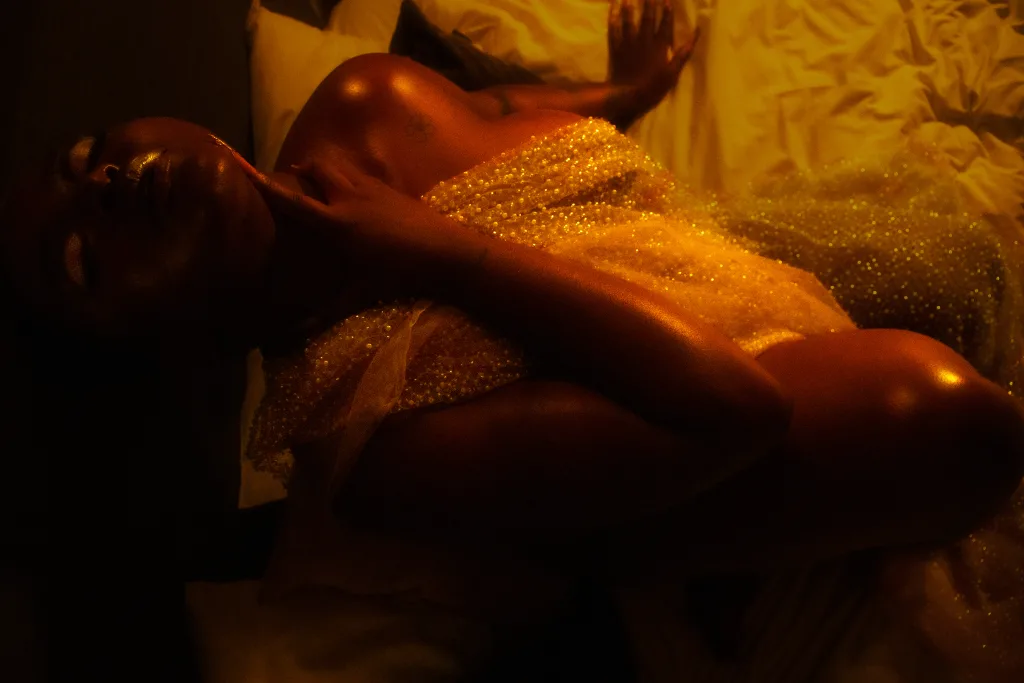
For close to 15 years, the Pan-Africanist digital platform, HOLAAfrica (HOLAA!), has been producing work that focuses on sex and sexuality on the African continent. For its latest project, HOLAA!’s founders – sex positive practitioners, Tiffany Kagure Mugo and Siphumeze Khundayi – have put together a collection of albums featuring African erotic stories billed as “a celebration of LGBTQ+ intimacies in their own words and voices”.
Titled Kivuli & Nuru: The Afrodisiacs Collection, the collection was born out of “a need for more sexiness, more sensuality, more deliciousness when it comes to African sexuality”.
Of the collection – which gets its name from the Kiswahili words for ‘shadow’ and ‘light’ – Mugo says: “The albums are explorations into the different ways we love and lust in both covert and open ways.”
Featuring stories from Lagos to Nairobi, from Cape Town to Cairo, the anthology features contributions by artists such as Mercy Thokozane Minah, writers such as Mia Arderne, prize winning author Jarred Thompson, international authors such as Kobby Ben Ben from Nigeria, and a cameo from Mpho Tutu van Furth, daughter of the late Desmond Tutu.
In this ‘In Conversation’ piece, Carl Collison and Mugo unpack the misperceptions around queer sexuality, the political importance of expressing desire, and the magic of hearing African queer voices sharing stories of sex and sexuality.
Carl Collison (CC): I wanted to say, just off the bat, how I love that most of the stories center the voices of women. I don’t know if it’s just my limited references, but I feel like when we talk about queer desire, generally, it’s mainly the male voice – the gay male voice, in particular – that gets prominence. There seems to be very little foregrounding of LBQ stories…
Tiffany Kagure Mugo (TKM): I think, for me, the idea comes from even within straight spaces: that sex and horniness and all of that stuff is for men. And for women, it’s that idea that we’re not that into sex, but because we were partnered – in straight cases, partnered with men – then we’ll be about that sex life. I’ve heard this, even to this day, in this whole big 2025, where [men are saying], ‘No, you know, women aren’t that into sex’, or ‘She’s ducking and diving my sex, so I have to go and find it somewhere else, because, you know, men need it.’ And I’m like, ‘Nah, my G.’ (Laughs.) So, I think when you take [that] to the queer realm, it becomes that thing of, like, now that there’s no barriers to sex, AKA women, that’s where all the sex is happening.
There was a time when people were talking about ‘lesbian bed death’ and how, at some point, queer women are just going to stop having sex because that’s just the way it goes. And it was something that was so prominent and so engraved, that it had to be debunked. Like, it had to be genuinely debunked. So, I think it’s just a universal idea that sex is for men and not for women. And that the minute you take out the male parts of sex and sexuality and desire and stuff, it lasts for a little while and then it’ll whittle out.
CC: Wait… What is ‘lesbian bed death’? I’ve never heard of that.
TKM: So, lesbian bed death – God, please let me not resurrect it (Laughs) – was [this] idea that, at some point in a queer woman’s relationship, they would stop having sex. The sex would just fall away. And it was just the most natural progression. It was going to happen to all queer women couples. And it was one of those things of, like, ‘Wait, why does it happen?’ People didn’t even try to unpack why it happens. It was just [seen as] this is inevitably what’s going to happen to women, because this is what’s always happened with straight women in straight relationships: they get to a point where they just don’t want to be with their partners anymore. So, now that there are no men trying to push it forward, that’s what’s going to happen to lesbian women. And that’s what lesbian bed death was: [the idea] that the sex, at one point, is going to die. Not because of any particular thing. It’s just gon’ die.
CC: But I mean, surely there are some points in even gay relationships where they kind of lose their…
TKM: It’s like the phases of any relationship… It’s just the phases of any relationship, where – to go all Christian on y’all – you’ll go through seasons. You know, seasons of abundance, seasons of sowing, seasons of whatever. It’s just the way. And if you’re together long enough, you will go in and out of those things. Like, for people who’ve been together for over a decade, you have not been fucking like rabbits the whole time. And if you have, you broke up at some point. Just tell the truth and shame the devil. (Laughs.) So, I think it’s one of those things that it became the idea of that dichotomy where gay men are in bathhouses and doing this and taking poppers and Grindr is a thing, and you don’t know anyone’s name. Whereas on the other side, lesbians will settle down instantaneously and the sex will die like old married couples, because they’re too busy doing, I don’t know, carpentry or pottery or whatever. (Laughs.)
CC: It’s so weird how we, as queer folk, internalize and take on these patriarchal notions of… well, just about everything. It’s so bizarre. Like, we should be offering new ways of existing, but we’re not. We’re just, I don’t know, perpetuating these kinds of patriarchal ideas of how we should move through the world…
TKM: In our defense, though, we already have enough on our plate, not being straight. Now, imagine being told today, ‘Hey, Carl, completely reinvent the wheel.’ You’d be like, ‘No, no, no, wait, wait, let’s take some of the things we understand about the wheel and push aside some of the things that we can’t use. But let’s keep the wheel in general.’ I’ve been thinking about that lately – especially [at] my whole big age – how, the older I get, the less revolutionary I get, [and] the more I’m, like, it’s so exhausting to be revolutionary. It’s so tiring.
So, you’ve got enough to think about as a grown being without having to now figure out new ways of living and loving. Leave that to the revolutionaries and let it be like ‘trickle down sexonomics’. You know what I’m saying? Like, leave that to the thinkers who can think about it. You just try and do what you can the best [way] you can.
CC: I hear you. I think most of HOLAAfrica’s work, in terms of centering sex and desire, particularly within an African context, is so important. If I think of my own journey, where, like so many queer people, from the get-go, I was shamed by society for having these desires or for having different desires. And then you kind of internalize that societal shame. And then, like me, I was a drug addict for a long time and I used drugs for sex and for connection. But it was all so broken, you know? There was just this brokenness around desire and expressing desire. And so now, at the age of 51, I’m coming to a healthier, more wholesome way of viewing and expressing desire. But I still grapple… Like, I love the title of this body of work, Kivuli and Nuru – ‘shadow’ and ‘light’ – because, as much as I find light in expressing this newfound way of expressing my desire in a healthy way, I still do feel some kind of shame. Like, as sex positive as I think I am becoming, would I chat with my parents about my desires around the Sunday lunch table? Definitely not. (Laughs.)… That was a bit ‘TMI’, sorry… (Laughs.)
TKM: No, I appreciate that because it is a journey, right? It is a journey. Even with me, [at] my whole big age, [with] my whole big work, there are still moments where I have to unlearn things, and not feel shame about things, and think about things. It is genuinely a journey. And also, let me just debunk the idea that sex positivity means that you can just talk about sex all day, every day. (Laughs.) [There is a misperception that] people who are loud about their sex [are] automatically [seen as being] sex positive. And that is not the vibe, right?
For us, as HOLAA!, we saw that a lot: how we [as a queer movement], we’re talking a lot about rights and we’re talking about, you know, ‘being queer is legal in this country, but illegal in [that] country’. Or [not being able to] access documents. It was always just this big macro thing. And so the idea of what it is for us to be individuals and in our intimate spaces – intimate beings within this queer space – that is what we’re trying to focus on. And desire is such a big part of that. Because our desire has been weaponized against us as queer people. So, that’s a lot of the work that we’ve focused on: demystifying, not only for ourselves, but also for outside folks. Like, it’s not that deep. Like, when you lay awake at night wondering what the gays are doing, it’s not that deep. It’s really not that deep. (Laughs.)

CC: I get you. I think the political importance of expressing desire can’t be overstated. Especially within an African context where you have African leaders talking about, ‘They’re eating each other’s poop’ or we’re all paedophiles or, you know, we’re these complete degenerates. So, yeah, there’s a real political importance beyond the titillation, beyond the sensory.
TKM: That whole thing of ‘the personal is political’…
CC: Yes…
TKM: Because it’s true. I had a conversation with somebody the other day, a queer elder. A whole queer elder (Laughs) told me to my face, like, ‘Yeah, [it’s] good, the work that you do, but you know, some of us need to do the immediate work.’ And I’m like, ‘What do you mean? What is the immediate work?’ And they were like, you know, ‘[Fighting the] anti-rights people’ and this and that. And I gave the example that, in Kenya, we had our own Harvey Weinstein situation within the queer community. So, what good is it if we’re pushing back against anti-rights people, but we’re protecting abusers in our own community, and we’ve got intimate partner violence. What is the point of all these lovely rights if you’re going home to get hit, if you do not know how to think, or you don’t know how to keep yourself [safe] emotionally’… Oooh, child, it got me upset.
CC: It’s also kind of a moral high-grounding, right? That kind of argument essentially puts one kind of way of being in the world above the other.
TKM: So, that’s a tricky conversation we as HOLAA! always have to have. Sure, more and more people are like, ‘Oh yeah, we’re going to look at intimate partner violence and this and that within the community.’ Now, we’ve been doing this for 15 years, but people are looking at it now and that’s fine. That’s great. But still you have moments where it’s sort of like, ‘No, we need to protest against the anti-rights conference that’s happening.’ Or ‘we need to figure out how we live in a Trump-filled world.’ And I’m like, ‘Y’all, yes, but also we’re more holistic than this.’
It feels like the argument that people have when we talk about race-based rights. It’s sort of like, ‘We’ll figure out protecting black women once we figure out the race issue.’ I’m like, ‘We’ll never properly figure out the race issue.’ But now people can’t even go to a Black Lives Matter rally without getting sexually assaulted. I’m like, ‘We need to have more range than this… please.’
CC: Agreed. If you could achieve one thing with this particular collection of work, what would that be?
TKM: I think one of the things that I would like to achieve – and it feels like a very lofty goal – is to make people a lot more comfortable with queer sex and queer desire by allowing it to be said in a voice that you recognize. Yes, it is all in English, but there are ways when you hear somebody who clearly speaks Kikuyu, or Zulu, or Kiswahili, or whatever it is, talking about these things.
And, you know, some of the sound effects [indicate] it’s happening in downtown Lagos, or a place where the Matatus (Kenyan minibuses) all congregate in downtown Nairobi or whatever. So, I think, for me, it is a demystifying, but also a locating of queer desire here at home on the continent. So, you’re not going out there watching The L Word. It’s somebody who’s like, ‘Yeah, so I went down to Kakamega and I saw my ex and this is what’s happening.’ Or going on a date to Kirstenbosch Gardens. These are places [where] you’ve been. So, shit, you could have been there when this story was being set.
And I think that’s what I want – for both straight and queer people – to be like, these stories are here. And to just have that message really land with people.
- Kivuli & Nuru: The Afrodisiacs Collection is available on Spotify, Apple Music or wherever you get your audio pleasure.