It is so difficult to explain to your children that one is not welcome in most churches because you are trans.
I have two kids. They are eight and nine [years old]. One of them really wanted to go to church. But in the area where I live, there is no church where gender-diverse people will be welcome.
We might attend – I don’t think we will be dragged out – but it won’t be acknowledged; it won’t be affirmed. And I was very concerned that if we arrived at a church, we would hear from the pulpit how, either we’re going to go to hell, or how bad or sinful it is.
So, in the beginning it was very difficult, because I had to explain to her why I believe it is not a positive thing to go to church at this stage. And also my concern [that] if I send one of them alone to church, what would be the narrative that they hear there and then come home with?
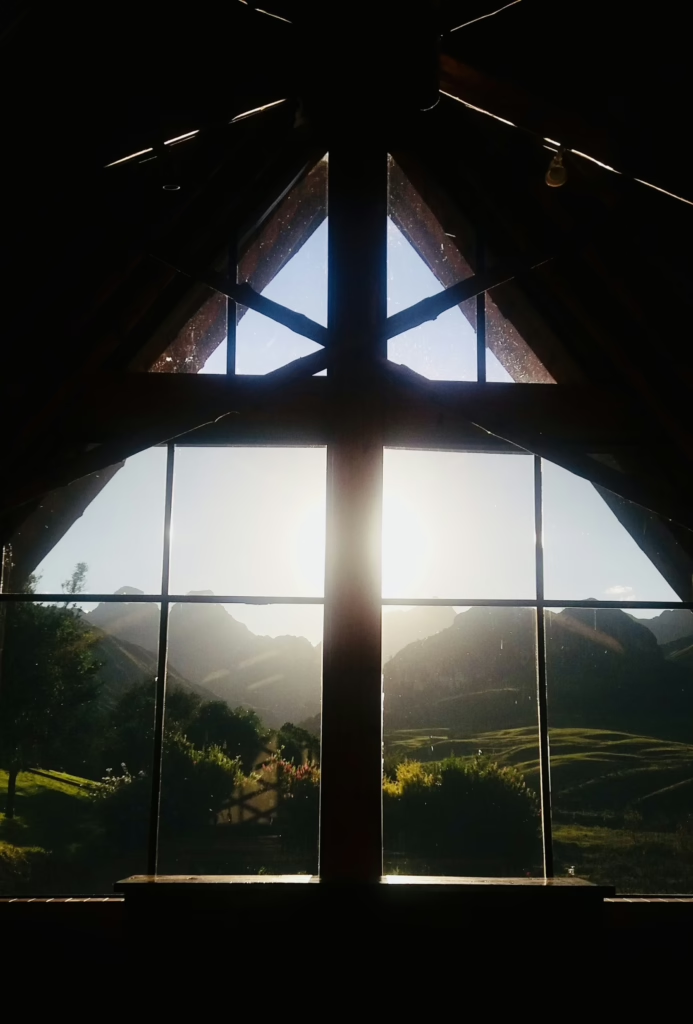
They once asked me why I am taking so many pictures of churches. It has always been a thing. I don’t know why I take so many pictures. It is, I guess, the symbolism of a very important part of my life.
Because I was very involved in the church. I studied theology. I’m an ordained minister. And it was always part of my life to take photos of churches. I find them fascinating. There is, for me, a symbolism in the buildings – a kind of a hope; maybe an aspiration to really learn about God. But then, of course, the fact that, quite often, the building does not hold the same impact. So the building becomes kind of hard and cold, in a way. Because the love that you hoped would be there, is often just meant for the people that toe the line.
When I was around 25, I left South Africa for two or three months to go and journey through Canada and America. But there I went to the gay-friendly church, UFMCC (Universal Fellowship of Metropolitan Community Churches). And because I travelled, I was in a different congregation every weekend. And there I learnt that churches can be inclusive.
I loved the feeling of being there – this feeling of being able to breathe, and really worship God. Because there’s nobody that’s going to frown at you or where you have to wait [for] when somebody is going to tap you on the shoulder to either want to convert you or passively ask you to leave. So, just that freedom to walk in [and see yourself] mirrored by other people and you are respected for who you are. You don’t have that constraint of living up to the normative expectations of other churches.
I studied through the Dutch Reformed Church and the AGS (Apostolic Faith Mission), but due to being queer I was unable to ordain within those churches. For years I tried to change my sexuality and gender identity – and this led to being unable to be ordained.
So when I was in Pretoria, I was part of the inclusive church, die Reformerende Kerk (the Reforming Church) and I’m also ordained in that church. But where I live now, we don’t have that.
I still do a lot of readings. I’m continuing with my ministry, although it’s outside the church. So, I still do baptisms, funerals and especially weddings. I basically marry the people that can’t be married in the church. So if they don’t attend enough, or the one is, let’s say, Roman Catholic, and the other one is Methodist, or Jewish and Christian, or whatever. So I continue with my ministry. And, I mean, I’ve married many, many people over the years. Because there are people that just can’t get married.
What do I want for my kids? Well, I would like them to have the freedom of choice: if they want to be believers or not; what religion they would like to follow – something which, obviously, the majority [of] Christian churches would frown upon as well … I can share my ideas of spirituality with them, but I would have loved that there were more opportunities [where we live for them] to engage with different spaces, without them having this fear of being rejected or even hated. Or me fearing that they will come back home and tell me, ‘Well, you’re going to hell’. Or them being traumatised by the church, hearing that I’m not worthy enough or whatever.
I want them to have the freedom to find their own voice and their own space in what makes sense to them. So at this stage, we find God in different ways: being in nature, being in the veld, looking at the Bible, telling stories to one another, and what we see spirituality as: you know, things like care and love and respect – and just being there for one another. – Kevin McCleary (not their real name)